Introduction
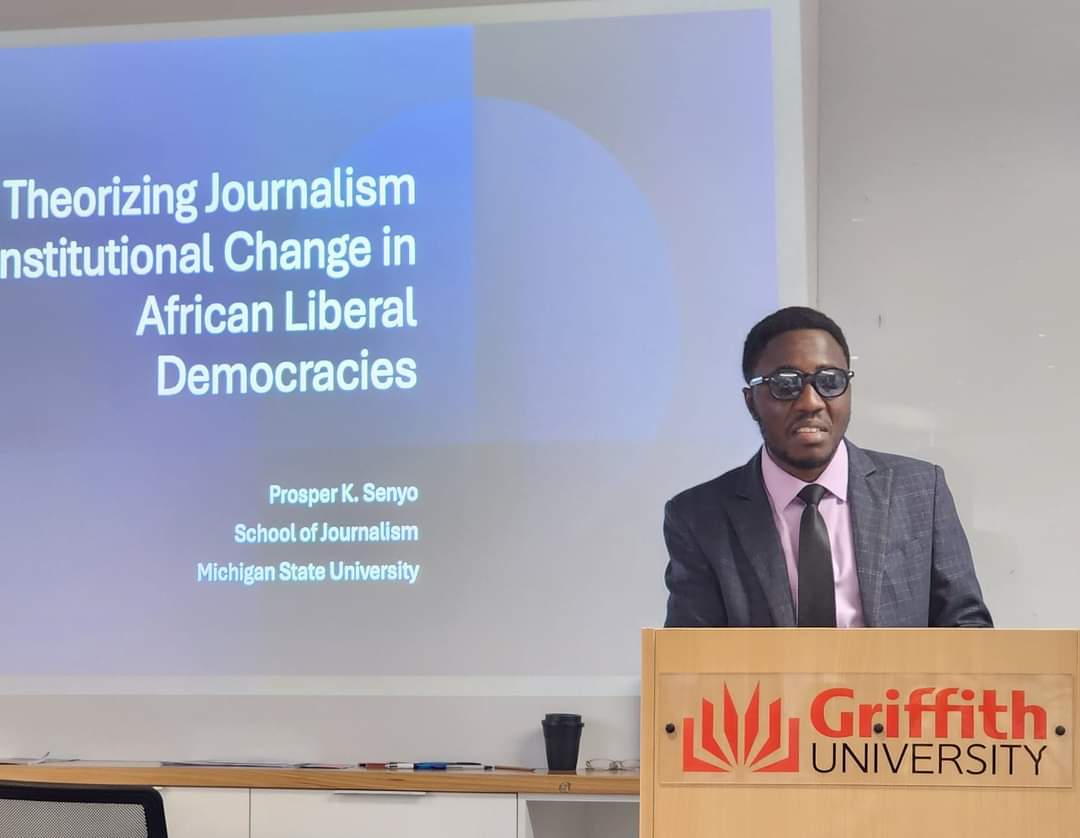
I believe scholarship should contribute not only to academic knowledge but also to public understanding. Alongside my research on media systems, journalism, and democratic governance, I engage broader audiences through journalism, public commentary, media appearances, and community engagement. My feature articles have appeared in Ghana’s biggest news outlets, including myjoyonline, citinewsroom and the Ghanaian Times. The goal is to expand this to global outlets.
Public Writing
Before entering academia, I worked at the intersection of corporate communications, international affairs and journalism, experiences that continue to shape my interests in public discourse, institutions, and democratic life. Across these activities, my goal is to connect scholarly research with conversations taking place beyond the university. At the center of my passion is the improvement of higher education, good governance and social justice. I have taken these fights to some of the biggest national platforms.
Featured Articles & Commentary
In this article published on myjoyonline, I argued for elevating the research profile of Ghanaian universities to meet the highest demands of innovation and problem solving, to make Ghana globally competitive.
“Take the practice of journalism for instance, and you’ll see that the skills and mindset needed for the profession are rapidly evolving with new technologies and political systems. The success of the modern journalist, may lie, neither in closed books published in the eighties nor experiences gleaned in the 90s. Whether in journalism, marketing, public relations, finance and banking or any other profession, what industry needs in this modern age, is the kind of innovative capacity that produces new knowledge to meet new challenges.”
“I have always written to support the government’s attempts to raise the quality of the human resource in our universities. The PhD requirement, as I have argued is in order. In recent publications on this platform, I made my arguments in support of the PhD requirements clear. The problem here however as always, is how good policies can be thoughtlessly and mindlessly implemented“.
I once again take the fight for quality high level education to one of the biggest national platforms in Ghana.
“There was uproar here when two French scientists suggested that, Africans should be used as the guinea pigs for new vaccines for the COVID-19. Rightly so! Except perhaps instead of political fallouts, there should have been a scientific backlash from Africa. Where are Africa’s own scientists who can respond to the French scientists in equal measure? And would our political response erase the reality, which is that, at the end of the day, Africa is looking towards the West for a vaccine for the pandemic? Is Africa low on the knowledge chain? If so, why? And what can be done to remedy the situation? These are the questions I attempt to answer in this essay“.
“A truth shackled to race, continent, nation, tribe or ethnicity can in no way liberate. A truth that liberates, is a truth that has the power to educate, to enlighten and to ultimately control. A truth that is controlled by us is a truth that cannot control us.”
Rule of law and just governance has been at the heart of my public scholarship.
“It is rather a stage where a society’s collective conscience has so matured that, it is sensitive to principles of natural justice, natural rights and natural law. It is a society where both leaders and followers, have overcome selfishness, to the point where they could feel empathy even for their opponents, thereby build a consistent system where national laws, and how they are interpreted, are subservient to principles of natural justice, and common sense. It is a society where public officials are bound to the duties of their office, to work in the interest of a just and egalitarian society, rather than selfish and partisan interests.”
A more recent reflection on rule of law.
“I know some would offer counter arguments justifying this on “culture”. But culture is not static. Cultures are products of their age and circumstances. While I understand the need to appreciate each cultural practice in the context of its age, when injustice speaks loudly and clearly, we must listen and act. As the contexts offered as justifications for cultural practices change, so too must cultural practices change. Regardless of our ideological persuasions, it is hard not to notice the inherent gender injustices in our social structure.”
“The whole enterprise of critical thinking and all that we learn through education is geared at helping us establish reality with accuracy in order to guide our decision-making processes. The equations that we solve in school, the missing ‘x’ that we were constantly solving are simply attempts to develop the tools for establishing reality, the fundamental part of our sense making of our world and how subsequently, we organize our individual and social worlds around this reality. In essence, the missing ‘x’ at the center of equations is simply the missing solution to life puzzles, the realities that we must establish in order to survive.“